


Drunk Driving Laws Around the World
Planning a vacation involves plenty of research, from choosing must-see sights to learning about local customs. One area that's often overlooked is local law, yet understanding it can help you avoid unexpected problems.
Before you toast your vacation, drunk driving rules vary widely around the world, with some countries enforcing strict zero-tolerance policies. You might choose to enjoy alcohol responsibly while traveling if you're driving later in the day, and in many countries, that's very much acceptable, as long as you're under the limit when you're behind the wheel.
Here at global car rental comparison site DiscoverCars.com, we've put together a guide on legal driving limits around the world, which illustrates just how much different countries' approaches vary.
Methodology
We gathered data on each country's drunk driving laws, including the blood alcohol concentration (BAC) limit, and how much drivers might be fined, as well as other penalties such as having their license temporarily suspended.
We used data from individual countries' government, police and Highway Code websites, as well as referring to the European Transport Safety Council. We also drew on information shared by lawyers' websites regarding the laws in their local country. All the information was correct at the time of writing in January 2026, and the research included looking into which countries are set to change their drunk driving laws soon.
The data
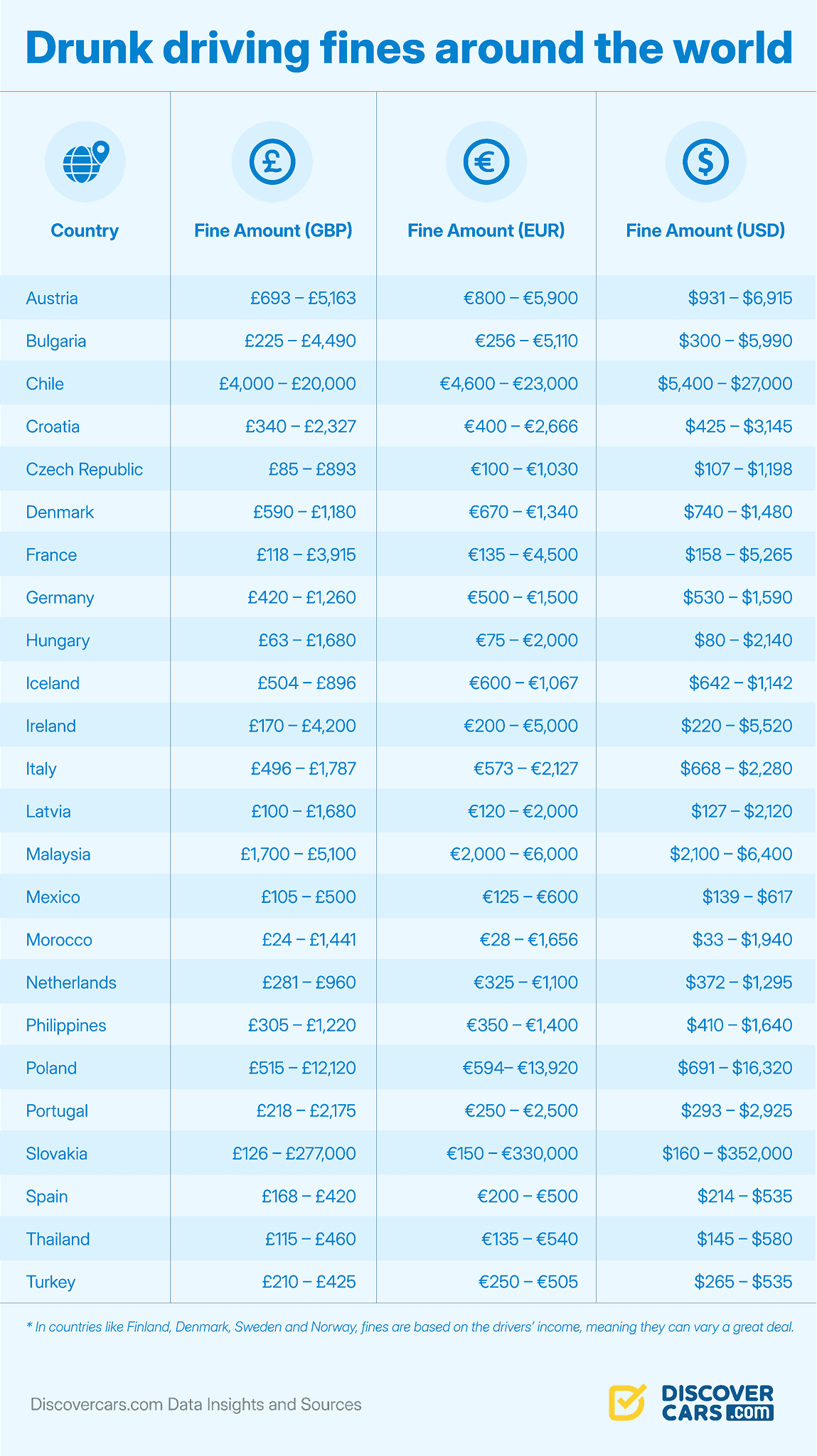
In Andorra, those caught driving with a BAC of 0.05% or above are liable to pay a fine of between €400 and €600. However, on top of the fine, it's standard to suspend drivers' licenses, with a 2-month suspension standard, although this could be extended as long as 6 years for repeat or severe violations. Drivers' vehicles will also be impounded.
Albania has a strict blood alcohol concentration limit of 0.01% for all drivers, making this country one of the strictest in Europe when it comes to drunk driving laws. The fine will be from €52 if their alcohol level is 0.03% or lower, up to €208 if it's as high as 0.08%-0.1%. Serious violations could see drivers given prison sentences. Refusing to agree to a roadside breathalyzer test could also see drivers fined €208, and it might also lead to having their license suspended.
In Croatia, the fine for driving with a BAC of 0.05% or higher will be between €400 and €2,666, depending on how much alcohol is in the driver's system. However, it's a zero-tolerance policy for both professional drivers and drivers under the age of 25.
The range of fines that drivers face in New Zealand is even broader, from a €99 on-the-spot fine if your BAC level is between 0.05% and 0.08% up to €2,965 for more serious or repeat offenders. The legal limit is 0.05%, with those with a BAC level higher than 0.08% attracting more severe penalties. Drivers might also be jailed for up to 3 months for their first or second drunk driving offense.
India has one of the lowest BAC limits we've covered so far in this piece, with drivers who have more than 0.03% blood alcohol concentration in trouble with the law. Since new drink driving laws were brought in to raise the fine in 2025, the penalty might be from €95 for first-time offenders, and a first offence could lead to up to 6 months in jail. Drivers who refuse to take a breathalyzer test when requested will be immediately arrested. While there isn't a different law for younger or novice drivers, there are different laws on when you can drink across India, with some states prohibiting alcohol entirely.
In South Africa, where the BAC limit is 0.05%, drunk driving could lead to a fine of €104–€6,276. At a minimum, drivers will also see their license suspended for 6 months. For very serious drunk driving offenses, penalties can include imprisonment for up to 6 years.
Brazil has a zero-tolerance policy, and drivers with any detectable alcohol in their system will be fined approximately €443, with repeat offenders charged more. People driving with a BAC level of more than 0.01% can also be barred from driving for 12 months, while a more serious offence could result in a prison sentence of up to 3 years. If the driver's BAC level is 0.06% or over, their license will be suspended and they may also be arrested.
In Chile, while the BAC limit used to be 0.08%, it was lowered to 0.03% in 2012. Those driving with a higher blood alcohol concentration than this will be fined between 1 and 5 UTM, Unidad Tributaria Mensual or Monthly Tax Unit. This is an amount that changes every month based on inflation, and as of December 2025, the current value of 1 UTM is €65. A limit of 0.03% BAC means that a small glass of beer or wine could render most people unable to legally drive in Chile. For those whose BAC level is between 0.09% and 0.1%, the penalty may include imprisonment ranging from 61 to 560 days.
In Malaysia, the BAC limit is 0.05%, with a fine between €2,000 and €6,000 for those caught driving over the limit, who may also have their license withheld for 2 years. They could also be imprisoned for up to two years. Second convictions can result in a higher fine, a longer driving ban or longer imprisonment.
The BAC limit in the Philippines is also 0.05%, with a first offense resulting in a fine of €288–€1,153, as well as 3 months imprisonment. While non-professional drivers will have their license revoked for 12 months, professional drivers will be banned from driving for life. Drivers who refuse to take a mandatory breathalyzer test will have their license confiscated and revoked.
Another country where the BAC limit is 0.05% is Turkey, where first-time offenders can be fined €231 and have their license revoked for 6 months. If caught driving under the influence again within the next 5 years, they will be banned from driving for up to 2 years. There is also a significant fine of €662 for drivers who refuse a breathalyzer test when suspected of drunk driving, and their license will be suspended for 2 years.
Finland's BAC limit is also 0.05%. In this country, fines are based on the driver's income, with one 'day-fine' working out as half the driver's daily income, with a minimum possible day-fine of €6. Those caught driving with more than 0.05% blood alcohol concentration will be fined between one and 120 day-fines. Instead of having their license revoked, in some cases, drivers can agree to have an alcohol interlock system installed in their car, which means the car will not start until they provide a breath sample that proves they haven't been drinking.
This system for fines is fairly common in Europe. Switzerland, Estonia, Norway, Denmark, Sweden, Germany and the UK can also all impose fines based on income, meaning that for high earners, the amount they have to pay can be very high. However, these fines are more likely to be imposed for very serious drunk driving offenses, with a lower fixed rate penalty more common among those who were slightly over the legal limit.
In Denmark, the limit is 0.05%. Driving with a very high blood alcohol concentration of 0.2% — more than ten times higher than the legal limit in neighbouring Sweden — will lead to drivers' cars being seized. Cars are also impounded when the driver is a repeat offender who has been caught drunk driving more than three times in the past two years. Latvia, where the BAC limit is 0.05%, has a similar law. Drivers who are heavily intoxicated with a BAC level of more than 0.15% will have their cars confiscated. Since the law was introduced in late 2022, more than 2,000 cars have been seized. They are usually sent to auction or, in some case,s donated to Ukraine.
In France, those with a BAC level higher than 0.05% can also expect a penalty. If their BAC level is between 0.05% and 0.08%, they might be fined €135, but if it's higher than 0.08%, they might be fined as much as €4,500. Up until 2020, all drivers were required by law to carry an unused, single-use breathalyzer. While this is no longer a legal requirement, many drivers still choose to keep one in their car for peace of mind.
Greek laws specify that drivers must not have a BAC level higher than 0.05%, with novice drivers and professional drivers limited to a BAC level of below 0.02%. Those whose blood alcohol concentration is between 0.05% and 0.08% might receive a €350 fine plus a 30-day license suspension. A BAC level of 0.08% to 0.11% could lead to drivers getting a fine of €700, as well as having their license suspended for 90 days. Drivers whose BAC level exceeds 0.11% can be fined €1,200, have their license confiscated and have their car impounded. In 2025, Greece updated its traffic laws, making them stricter in order to crack down on drunk driving, speeding and other offenses. Driving over the limit can also lead to a prison sentence of 2 months to 5 years, or longer if an accident is caused.
In the Netherlands, there's a similar rule, with most people forbidden from driving with a BAC level higher than 0.05%, but a stricter limit of 0.02% for others. This includes professional drivers, those who have been driving for fewer than 5 years, and those who are 24 years old or younger. Drivers might be fined a minimum of €325 if their BAC level is between 0.05% and 0.08%, rising above €950 if their BAC level is higher than 0.18%.
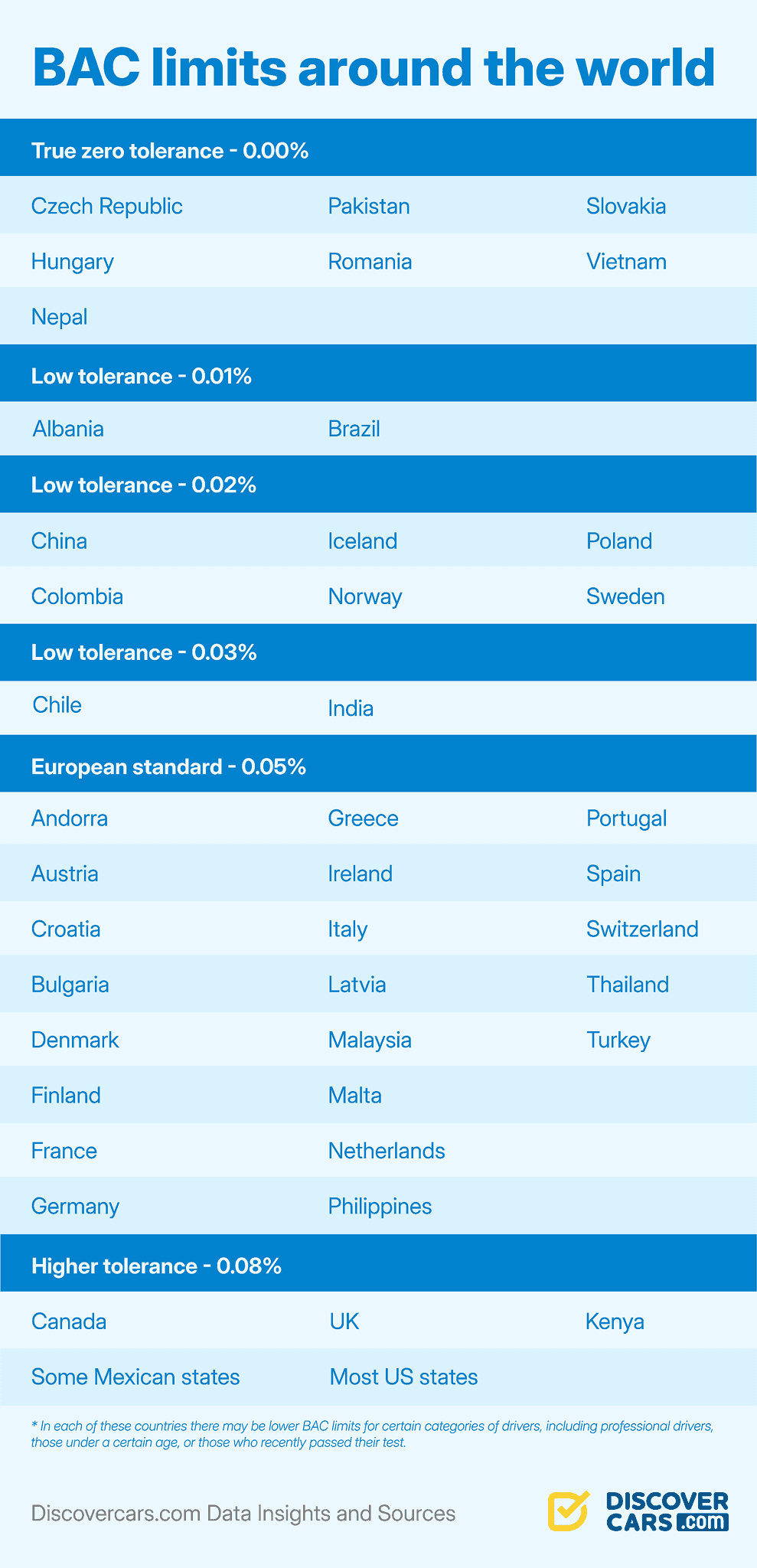
While in Spain the current drunk driving laws impose a BAC limit of 0.05%, a new reform is currently on hold in Parliament that would reduce it to 0.02% for all drivers. So if you're planning a trip to this country, you might want to check whether the law has been brought in before you go. The reform will bring Spain in line with other European countries like Norway, Sweden and Poland.
Finally, in the United Kingdom there are two different limits. In Scotland, the law states that you can't have a BAC level higher than 0.05% if you're driving. In England, Wales and Northern Ireland, the level is higher, at 0.08% — but the government has announced plans to potentially lower the limit in line with Scotland's rules. In the UK, driving over the limit or failing to provide a breathalyzer sample when asked can both lead to being banned from driving for 12 months, with more serious offenses leading to a longer license suspension.
Which countries have zero tolerance for drinking and driving?
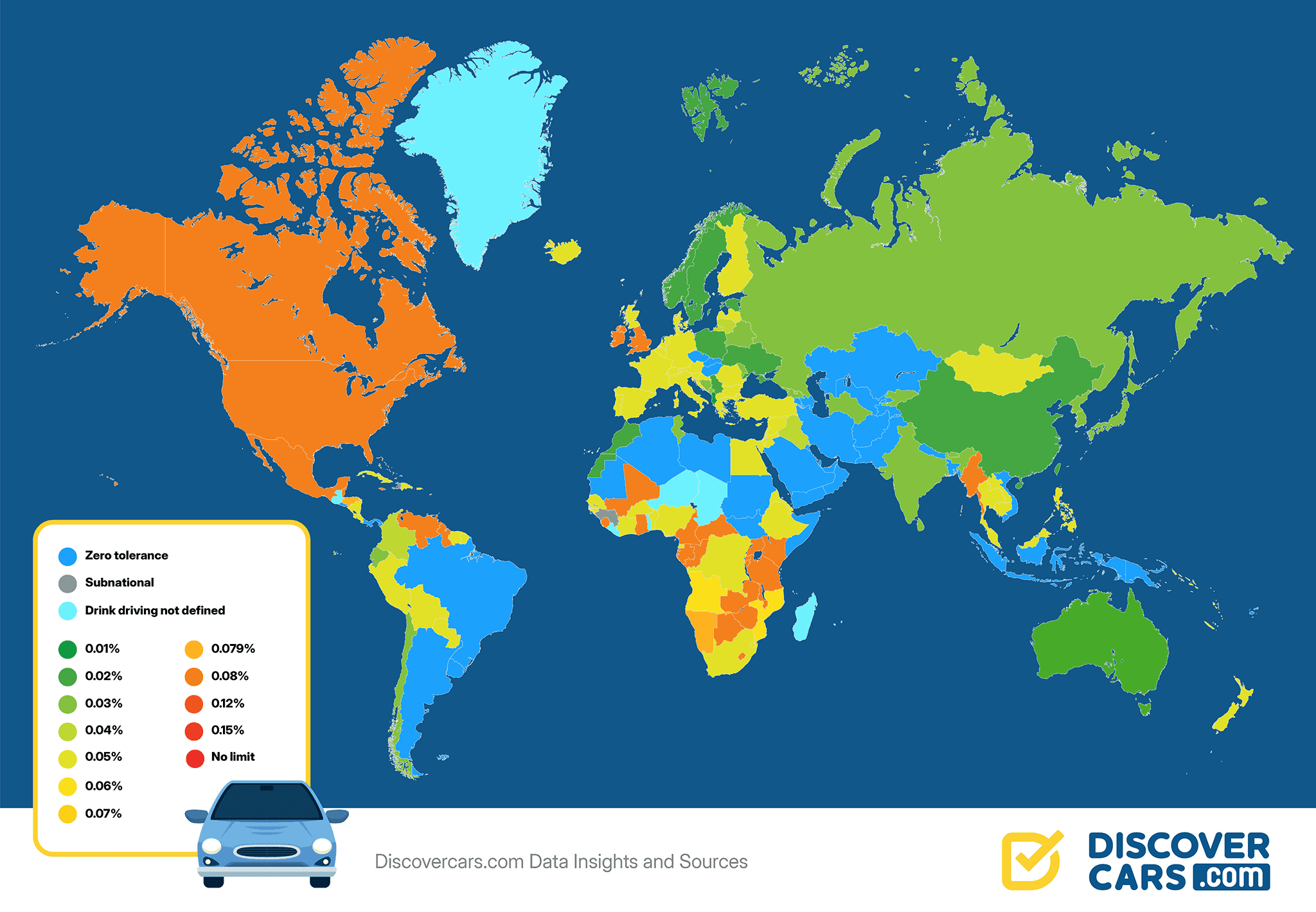
Many countries describe their policy for drunk driving as 'zero-tolerance', but they sometimes have a BAC limit that's slightly higher than 0.0%, including laws like Albania's 0.01% limit or Chile's limit of 0.03%. This is because the amount of alcohol that would put a driver over the limit is so small that the legal limit has been set with a margin of error in mind.
However, the following countries have a BAC limit of 0.00%, meaning that drivers can't have any alcohol in their system: Afghanistan, Algeria, Argentina, Armenia, Azerbaijan, Bahrain, Bangladesh, Brazil, Brunei Darussalam, Costa Rica, Czech Republic, Ecuador, Egypt, Fiji, Hungary, Indonesia, Iran, Iraq, Kuwait, Kyrgyzstan, Libya, Maldives, Mauritania, Mongolia, Nepal, Oman, Pakistan, Panama, Paraguay, Peru, Qatar, Moldova, Romania, Saudi Arabia, Slovakia, Somalia, Syrian Arab Republic, Tajikistan, Turkmenistan, Uruguay, Uzbekistan, Vietnam, Yemen.
As well as these countries that don't allow any drivers with alcohol in their system, there are countries that have a zero-tolerance approach just for younger drivers and those who haven't been driving very long. This is a very common policy, as these drivers with less experience might be more likely to make a bad call while driving that could put them or someone else in danger, especially if they've had a drink.
These countries are: Australia, Austria, Bosnia and Herzegovina, Canada, Colombia, Côte d'Ivoire, Croatia, Cuba, Democratic Republic of the Congo, Germany, Honduras, Iceland, Italy, Japan, Kenya, Kiribati, Kyrgyzstan, Lao People's Democratic Republic, Lebanon, Lithuania, Malaysia, New Zealand, Nicaragua, Norway, Romania, Saint Kitts and Nevis, Saint Vincent and the Grenadines, San Marino, Sao Tome and Principe, Senegal, Serbia, Slovenia, Spain, Republic of North Macedonia, Tunisia.
You can see that these laws are a very popular way for countries to reduce drunk driving, whether they're applied to everyone or only novice or younger drivers. Perhaps when people know the BAC limit is either zero or very low, they're less likely to take a chance on having even one drink, when they know this could score them a fine.
Final thoughts
With so much variation in laws around drunk driving and driving while under the influence, it's easy to see how someone might find themselves accidentally breaking the law while traveling abroad. That's why it's so important to familiarize yourself with the local laws before you set off.
Everyone metabolizes alcohol differently, and there's no solid way to know how long it will remain in your system, which is one reason why it might be best to avoid drinking at all on days that you plan to drive. Your age, sex, weight, metabolism and what you've eaten that day, including other factors like medications, can all affect how long alcohol will stay in your system.
If you're planning your next international trip or vacation, please consider booking your rental car with us. As a global car rental comparison site, we're committed to helping you find the best deal, with cars available to rent from many different companies. We operate in over 164 countries around the world.
Disclaimer
Blood Alcohol Concentration (BAC) levels represent the amount of alcohol that is in your bloodstream. For example, a BAC of 0.10% means that your blood contains one part alcohol for every 1,000 parts of blood.
All legal information relevant to drinking and driving limits and fines in featured countries is correct at the time of writing in January 2026. The research also included which countries are set to introduce new laws in 2026.
Please ensure you check the country's laws you are visiting to understand your responsibilities and rights.